

“What’s in a name?” Juliet once pondered on some balcony, and for newlyweds, the answer is – quite a lot, actually. While changing your name to match your spouse’s after marriage is not a requirement, it’s still a very popular option in Australia. However, even with so many people going through the process, there is a lot of misinformation or half-truths out there about what it means to legally change your name in Australia – with even a lot of celebrants not getting it quite right when trying to explain it to their couples.
So whether you are newly hitched, or you are wanting to continue your celebrant education, this guide will explain not just the how but also the what when it comes to name changes.
Short on time and would prefer someone else to do the name change work for you? Easy Name Change provides a fast, stress-free way for couples to complete all their name change paperwork.
Click here to find out more and save yourself a heap of time!
You may also want to read our article
WILL MY OVERSEAS MARRIAGE BE RECOGNISED IN AUSTRALIA?
Jump to:
What Does It Mean to “Legally Change Your Name”?
You’ve ticked off everything on your wedding planning checklist, you had the Big Day, exchanged vows, drank the Champagne, and now in the aftermath, you’re wondering, “when can I legally change my name after marriage?”. It’s a more confusing and ambiguous question than you might think at first glance, because technically speaking, the answer is “as soon as you want to.”
In Australia, we have a common law right or custom to be known by any name we want by usage or reputation. That means if I simply told everyone that I am changing my name from “Alison Pickel” to “Consuela Banana Hammock”, and everyone started calling me that, then I’ve changed my name by usage and reputation. (A common example might be someone who was born overseas, but adopts an “English” name when immigrating to Australia).
HOWEVER, this is a limited right, because other laws and policies will override it. For example, the Australian Passports Act 2005, has very specific rules about what name can appear on your passport.
It is also possible for most people to go through a formal name change process via the Registry of Births, Deaths and Marriages (BDM), though in many cases, this is unnecessary after marriage.
What usually confuses people is the idea that you haven’t changed your name until you have new ID in that name. That’s not exactly true. When you update official documents, such as your driver’s licence or passport, you’re simply informing organisations about your new name, not creating the change itself.
So when people ask “when can I legally change my name?” what they are really asking is “when can I start updating my name on my ID and with different organisations?”. And for that, you are going to need some documentation from the Registry of Births, Deaths and Marriages.
Updating Your Name in Australia After the Wedding
“Okaaaay,” you might be thinking, “that seems like a lot of legal semantics background information. Just give it to me straight!”
Simply put, in Australia, there are two main ways to change your name and update your documents after marriage:
- Through usage and reputation. This is a matter of custom rather than law. It relies on the BDM-issued Marriage Certificate* as evidence for updating your name.
- By officially registering a change of name through the Registry of Births, Deaths, and Marriages. In this case, you would be issued with a Change of Name Certificate and/or re-issued a Birth Certificate that can be used for updating your name.
Which option you will need to use after getting married will depend on your circumstances. Let’s explain both processes in more detail.
* The pretty certificate you receive on your wedding day (officially known as ‘Form 15’) is not considered an identity document, so it can’t be used to update your name in most circumstances. You’ll need the one issued by Births, Deaths and Marriages. Ask your celebrant about ordering this certificate as the process varies from state to state.

Changing Your Name Through Usage
Changing your name by usage is the most popular way to update your name after marriage. This is the method you would use if:
- Your marriage ceremony took place in Australia; AND
- You are only changing your surname to one of the following:
- taking your spouse’s surname in place of your current surname
- combining your surnames with a hyphen (e.g., Smith-Jones)
- combining your names without a hyphen (e.g., Smith Jones)
No Formal Process
What’s great about this method is there is no formal process to changing your name through usage. You don’t need to fill out a form or go through a legal application. You simply start calling yourself by your new name!
That also means as soon as you have your Official Marriage Certificate from BDM, you can start updating your ID.
Your BDM Marriage Certificate will list the names you and your spouse were using at the time you got married. You can then show that certificate to different organisations to say that you wish to use your spouse’s surname (or add your spouse’s surname to your current surname).
Flexibility to Revert to Your Birth Name
Changing your name by usage doesn’t mean giving up your original name (also called maiden name or pre-marriage name) permanently. You retain the right to use your birth name for legal purposes and on your Government-issued ID. This means you can:
- Delay updating documents like your passport or driver’s licence if you still need to use your birth name.
- Return to your original name without a formal process if you decide the new name isn’t for you.
- Use both or either name when it suits you. For example, some people like to keep their birth name for professional purposes or for legal documents, but choose to use their married name socially or on social media.
Limitations of Changing Your Name Through Usage
Although this method is simple, there are limits. Let’s take Australian Passports as the gold standard example of what name can be used when supplying a marriage certificate as evidence.
Section 53 of Australian Passports Act 2005 says that to change your name on your passport after marriage, you will need to supply a marriage certificate issued by an Australian Registry of Births, Deaths and Marriages (an overseas marriage certificate can’t be used), and that you can only change your surname using this document.
Other circumstances will require a formal change of name via BDM.
Most states and territories in Australia have similar requirements when it comes to updating your driver’s licence.

Changing Your Name Through BDM
In some cases, a formal name change through the Registry of Births, Deaths, and Marriages is what will be needed. Here are some examples of when that might apply:
- You were married overseas, but you live in Australia
- You want a completely new surname that is not your spouse’s current surname (e.g. instead of ‘Smith-Jones’, you want to be ‘Smones’)
- You want to update your first or middle names in addition to your surname
How to change your name via the Registry of Births, Deaths and Marriages
If you were born in Australia, you’ll apply to the BDM office in the state or territory where you were born.
If you were born overseas, you’ll apply in the state or territory where you live. You’ll need to have lived in that state or territory continuously for a certain amount of time which will vary depending on the location.
There are also limits on how often you can change your name this way and restrictions for certain groups, such as inmates or individuals under specific legal conditions, so be sure to check the requirements in your state.
Here are links to information on how to change your name via BDM:
Important things to know about registering a change of name via BDM
Unlike the usage method, reverting to your pre-married name after a BDM name change requires another formal application. When you change your name via BDM you are essentially saying that you renounce your birth name and don’t want any legal connection to it anymore.
Another thing to be aware of is that some laws and policies strict timelines for updating official documents when it comes to changing your name. For example, in New South Wales, you must update your driver licence within 14 days of your name change.
If doing a change of name through usage, you can update your documents in your own time, because you can still legally use your birth name, but with a formal change of name process, you’ll need to hop to it when it comes to updating details.
How to Update Your Name on Documents
You have your Official Marriage Certificate or Change of Name Certificate from BDM – now what?
Unfortunately, there’s no magic system that updates your name across all organisations at once. Instead, you’ll need to notify each one individually.
We recommend starting with photo ID and important Government organisations first, such as your driver’s licence and Medicare, then work your way down to things like banks, utilities and insurance companies.
Services such Easy Name Change can streamline this process by providing forms and templates for various organisations.
If you are heading overseas for a honeymoon shortly after the wedding, hold off changing your name on your passport until you are back, as your passport will need to be in the same name as your plane tickets.
Here are some links to get you started:

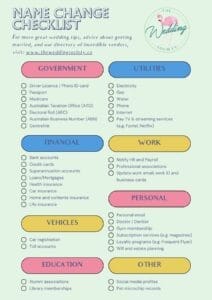
Bonus: Download Our Free Name Change Checklist
Looking for a comprehensive list of everywhere you may wish to change your name? Download our free name change checklist which has clickable check boxes to help keep you on track.
Frequently Asked Questions
Who can change their name after marriage?
Either or both parties to the marriage can change their name after the wedding. While the bride changing her surname to match the groom’s is still the most popular scenario in Australia among opposite-sex couples, there is a growing trend seeing more men taking on their spouse’s name or both parties changing their names.
Do I have to change my name after marriage?
Absolutely not! This is a personal choice. In fact, in many cultures it’s more common for people NOT to change their name after marriage.
When do I have to change my name?
There is no time limit on when you need to change your name after marriage. Some people initially choose to keep their pre-married name, then change it after they start having children, for example. Or some people just aren’t keen to do a lot of extra paperwork straight after planning a huge wedding. It’s entirely up to you when you would like to change your name, if at all.
I was married overseas. Can I marry again in Australia to get an Australian marriage certificate so I can change my name?
In most cases, no. Usually, if you were legally married overseas, and you could have married in Australia (i.e. you’re of legal age, not married to anyone else, not in a prohibited relationship, and you consented to the marriage), then your marriage is automatically recognised in Australia.
You cannot register your marriage in Australia, but it is still legally recognised, meaning you cannot marry again while the marriage is still valid. Your best option here is to go for a formal change of name process via BDM.